
Leveraging SPACE for reducing child and teen anxiety and OCD, whilst strengthening family systems
This blog was originally written for therapists, however I decided to share it here and hope it helps parents in understanding SPACE therapy. Some of the wording may still sound worded at therapists, but hopefully the bulk of the article is useful and supportive for parents.
Anxiety disorders have been on the rise in young people creating large societal problems with school avoidance, phobias, social isolation, loss of identity and delayed developmental milestones. Anxiety disorders don't just rob the young person of opportunities, it impacts the whole family. As a children and young person (CYP) therapist sometimes this is the saddest part for me. Seeing how the family dynamic gets strained and rifts created. Relationships are a cycle of rupture and repair, however in anxiety disorders and OCD the ruptures are so frequent repairs don't happen quick enough. Which often results in resentment, anger and disconnection for all. Three factors not conducive for healthy relationships. In all CYP work it's important to work with the family system, or at least keep it in mind, however in OCD the family get so entangled in the symptoms that if we don't help the family notice this pattern of maintenance then the work we do in session can be undone at home. That is where the therapy Supportive Parenting for Anxious Childhood Emotions (SPACE) is useful. Offering parents (or caregivers) a strategy on how to support and not reinforce the cycle of OCD.
What maintains OCD?
Anxiety and OCD is maintained in part by negative reinforcement. As the family accommodates their loved ones anxiety the anxiety and or worries are reduced. Offering their brains a sense of safety and certainty around the fear, the anxious cycle is then reinforced through learning to depend on the caregiver for regulation around the fear. As a CYP therapist I talk about regulation, however in OCD and anxiety the traditional ways of reassurance and other accommodations around the OCD only perpetuates the cycle and keeps anxiety disorders going longer than needed. Accommodations are present in 95% of parents with anxious children(1), and linked with more severe anxiety symptoms(2). Why do parents accommodate their children if it’s so unhelpful? Because they care. I know as a parent if my child is suffering I want to alleviate that pain as quickly as possible. But sometimes the quick path isn’t the best in the long run. And in anxiety or OCD work it is paradoxical by nature. The most caring thing is not to alleviate our loved ones distress through the obvious means such as reassurance giving around the worry, or doing something for them that their brain is anxiously demanding but rather helping them learn that they can tolerate these feelings and riding it out. Therefore caring may look more like support around their resilience with a dose of hugs, rather than addressing the worries directly. Which may feel counterintuitive to most parents.
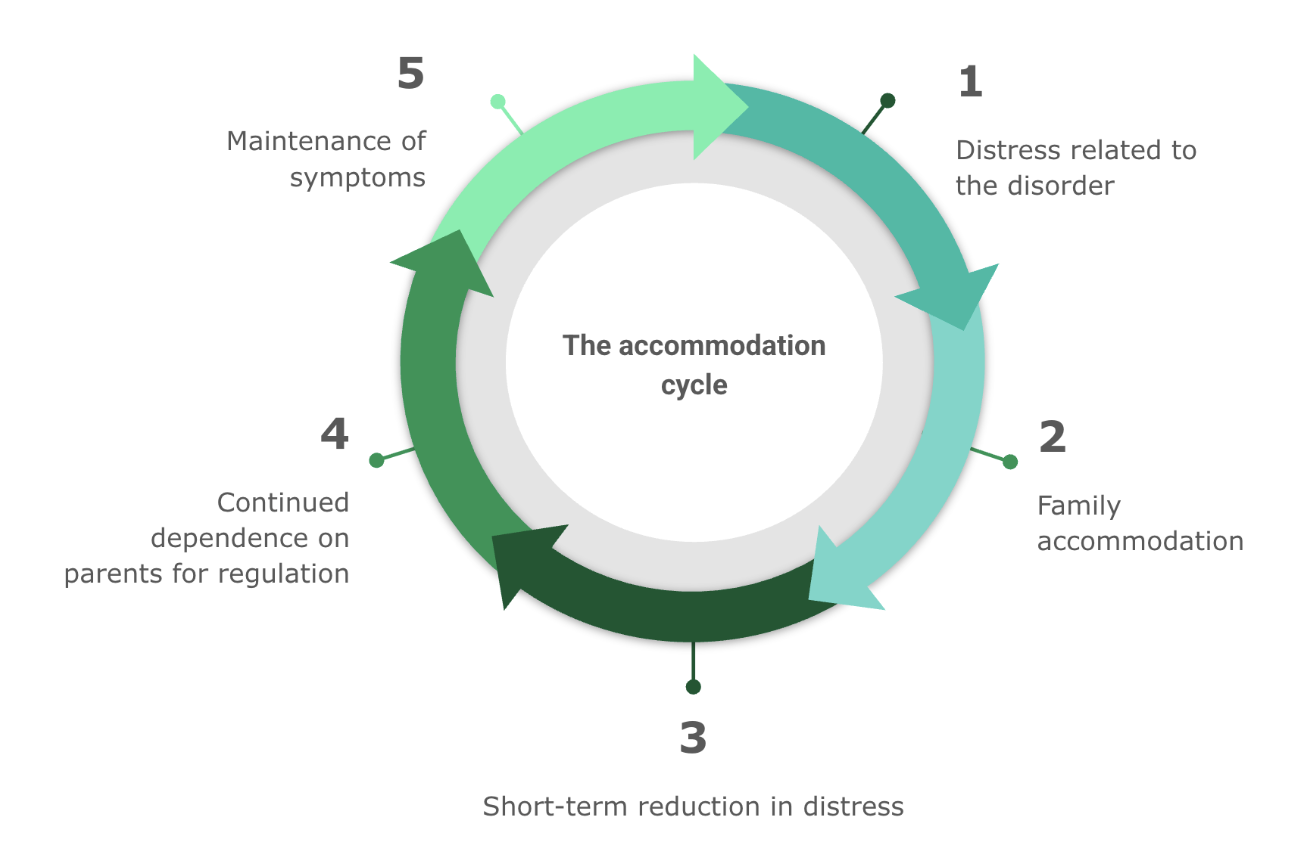
Fig 1: Family accommodation cycle
The family accommodation cycle mirrors that of the child's OCD or anxiety cycle. With the exception for the child they depend on their own compulsions for regulation, whereas in the family system the child also leans on the parents accommodation - it could be viewed as the parents doing a compulsion on the child's behalf.
SPACE as a solution to this vicious cycle of OCD
SPACE was developed at Yale University in the United States as an answer to when children experiencing anxiety disorders and OCD did not want to see a therapist. Dr Eli Lebowitz and associates developed SPACE as a tool to engage the parents in reducing the things they had control over that was maintaining anxiety and OCD, and the behaviours they were doing out of love but were only exacerbating the child's anxiety. A SPACE trained therapist works with the parents each week, over 8 to 12 sessions to identify accommodations, then reduce them, all the while increasing support. The weekly parent coaching with SPACE supports the parents in all the uncertainty and shame they may feel around the situation. I have seen anxiety and OCD tear families apart; from the parents having to get involved in endless hours of compulsions such as reassurance giving, listening to confessions, washing, hiding objects, avoiding places and people, to limiting the home through no visitors allowed, and the parents not being allowed to go out except when necessary. SPACE offers the parents and caregivers a strategy to lean on in the storm of anxiety and OCD.
SPACE was found to be as effective as CBT for anxiety in one study(3). SPACE empowers the parents through giving them a sense of control in an anxiety or OCD controlled home, can reduce the parents stress which can help them show up with more empathy, helps build bridges with the child, and supports them in setting healthy boundaries which are important for children. Equally, I feel SPACE helps the child through creating new learning from their fears (usually achieved in one-on-one exposure and response prevention therapy), helps the child feel increased support that doesn’t make symptoms worse in the long run, and helps the child feel more contained through firmer and more predictable boundaries.
Even though the child does not have to actively participate in SPACE the parents do communicate they are getting support and will start to systematically reduce accommodations, while explaining that they love their child and they don’t want to participate in what is keeping the OCD going any longer. This is communicated through a letter that is best delivered on paper to the child. This is for impact. When was the last time most parents hand wrote or printed a letter out to give to their child? So when the child receives this letter in this form it signals intent and the seriousness of the parents doing this work. *SPACE is often done when the child is not going to therapy because they don’t want to or can’t engage right now, and the home has become ruled by the symptoms and the child themself is deteriorating. So it is all pretty serious. Thereafter, the parents verbally communicate the next reduction in accommodations often when the last accommodation reduction has been seen through by the parents.
*SPACE can also be done with the parents alongside the child receiving their own therapy.
Accommodations 101
Accommodations are tracked and then targeted each week in collaboration with the therapist. At first some parents may suggest they don’t accommodate much. But after some inspection a large list unfurls. It can be key to ask parents these questions: do you give reassurance around the anxious worry?, do you protect them through hiding things or topics as to not trigger their anxiety?, do you do things in a certain way, order, or timing because of the anxiety?, can you move freely in your own home?, do they ask you to do anything for them because of their anxiety?, do they ever ask you not to do anything because of their anxiety?. There are many more questions but those are some useful ones to unearth the accommodations in the family. When reducing accommodations this should be done slowly and systematically with compassion, communicated to the child so there are no surprises, and to start with something that the parent is motivated to change as it can be hard reducing accommodations as it may spike their loved ones anxiety in the short term as they are no longer being regulated by the family accommodation, so the parents having a desire for a behaviour to change can help them ride out the uncertainty in those early days of SPACE. It’s important for both parents, or whatever the parental unit is is on board and in agreement about the strategy. It’s not a deal breaker but it can complicate things when one parent is not agreeing with the other. This allows an in for the child to push the new SPACE boundaries and eventually break them.
Support 101
In SPACE support is defined as offering validation, followed by confidence. Validation plus confidence equals support. Validating the child’s struggle, and giving them confidence in navigating their situation. This simple formula is important because going through OCD is overwhelming and can feel hopeless. When validating the child’s struggle the parents are showing that they see how hard it is, humans of all ages want to be understood. This can also reduce the teenager's response of, “you don’t get it”. And then offering confidence instills the belief they can handle it, ride it out etc. As in the midst of disordered anxiety I can personally tell you that you don’t think you can handle it, and on some level you’re left feeling like the experience will swallow you up. So having someone else remind us that we can do this, we can cope, and we will prevail is important. Over time, hopefully the child adopts this belief system which allows them to cope.
Support statements are used by the parents as a way of increasing support without reassuring the worries which would be an accommodation. As accommodations are reduced there is often push back from the child, these support statements are designed to help the child learn they are seen and that they can ride this out. To bring this to life it could look like, “I can see you are struggling (validation), and I know you can handle this”, or “I know how hard this is for you when we don’t reassure your worries, and we know you can ride this out”. We know this because humans are very capable, and sometimes we need to be reminded. Over time resilience is built and the child learns they can handle it.
Results
In my clinical experience I’ve seen great results with SPACE, and sometimes ok results, and sometimes no results. It’s worth noting that when OCD is running the home, even a slight improvement makes a difference to the lives of the parents and the child. Other factors can impact the effectiveness of the outcome such as comorbidities (other disorders and challenges), systemic problems, parental commitment to the plan, therapist confidence in the plan, pathological demand avoidance, self-harm, and more. None of this is a deal breaker, as it can all be often worked on and adjusted for. SPACE is no panacea however it is a useful tool that targets a known problem within the family of children with anxiety disorders and OCD: accommodations. As these accommodations are reduced the disorder is not being maintained by the family, with less negative reinforcement it is a matter of time before the behavioural loop weakens and the child’s life improves, and as a result the lives of the parents and other family members, which only benefits the child even further.
Wishing you all the best,
Stuart
P.S. To learn more about SPACE, we cover it in our 4-week parent support and education group. Find out more here >
P.P.S. Check out the SPACE self-help book for parents: https://www.amazon.co.uk/Breaking-Free-Child-Anxiety-Scientifically/dp/0190883529/
References:
1: Shimshoni Y, Shrinivasa B, Cherian AV, Lebowitz ER. Family accommodation in psychopathology: A synthesized review. Indian J Psychiatry. 2019 Jan;61 Suppl 1:S93–S103. doi: 10.4103/psychiatry.IndianJPsychiatry_530_18.
2: Lebowitz ER, Panza KE, Bloch MH. Family accommodation in obsessive‑compulsive and anxiety disorders: a five‑year update. Expert Rev Neurother. 2016;16(1):45–53. doi: 10.1586/14737175.2016.1126181. Epub 2015 Dec 22
3: Lebowitz ER, Marin CE, Martino A, Shimshoni Y, Silverman WK. Parent‑based treatment as efficacious as cognitive‑behavioral therapy for childhood anxiety: A randomized noninferiority study of Supportive Parenting for Anxious Childhood Emotions. J Am Acad Child Adolesc Psychiatry. 2020 Mar;59(3):362–372. doi: 10.1016/j.jaac.2019.02.014